
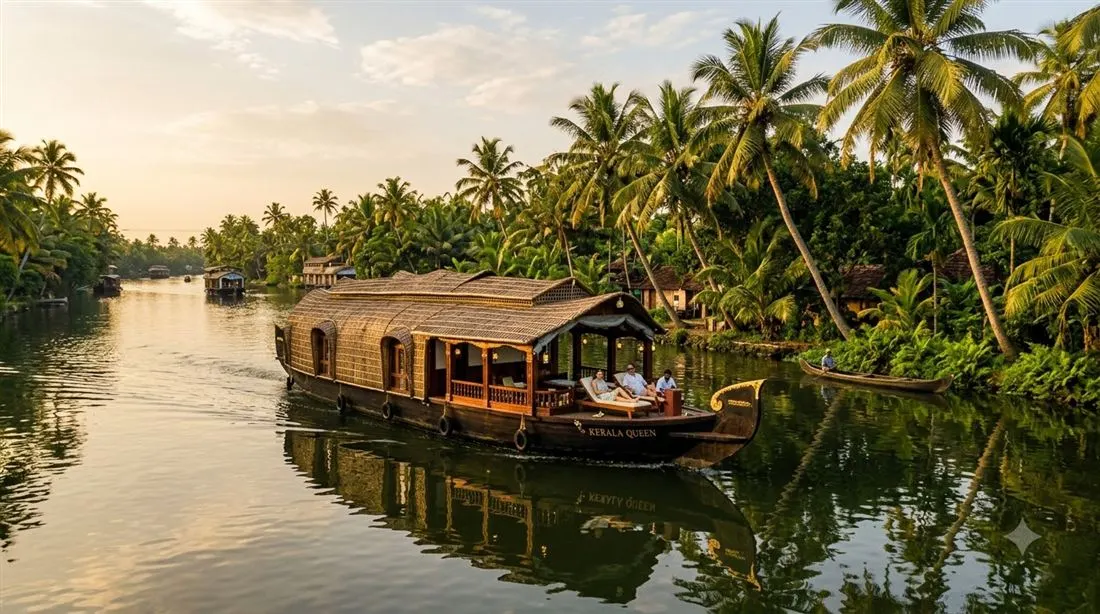
Almost every Kerala itinerary includes a houseboat, and almost every traveller asks the same question when planning one: Alleppey or Kumarakom? They sit on the same backwater system, an hour or so apart, but the experience of each is different enough that the choice is worth making deliberately.
What is the difference between Alleppey and Kumarakom?
Alleppey sits on a dense network of narrow canals and has by far the larger houseboat fleet, so cruising there means passing villages, paddy fields and daily life close up. Kumarakom sits on the open expanse of Vembanad Lake, is quieter, and leans more towards lakeside resorts than boat traffic.
Put simply: Alleppey is about the canals and Kumarakom is about the lake. If the images that drew you to Kerala are of a boat gliding between palms with children waving from the bank, that is Alleppey. If they are of still water and wide horizons, that is Kumarakom.
Which is better for a first Kerala trip?
Alleppey suits most first visits, because the narrow canal cruising is the distinctly Keralan experience and the choice of boats is widest. Kumarakom suits travellers who want a quieter, more resort-led stay or who are travelling with very young children.
Neither is a wrong answer, and a longer Kerala itinerary can comfortably include both — a night on a boat from Alleppey and a couple of nights at a Kumarakom property on the lake.
How many nights should you spend on a houseboat?
One night is the sweet spot for most travellers. You get the afternoon cruise, sunset from the deck, dinner aboard and a slow morning, without the constraints of living on a boat becoming tiring.
Two nights suits people who genuinely want to slow down and are happy with limited space and no shore excursions. Beyond that, most travellers are more comfortable moving to a hotel and taking day cruises instead.
Do houseboats cruise at night?
No. Houseboats moor for the night rather than cruising after dark, which is a safety and navigation practice across the backwaters. You will wake up where you stopped the previous evening.
This surprises people who imagined drifting through the night, so it is worth knowing in advance. The moorings themselves are usually peaceful spots by the bank, and the stillness of the water at night is genuinely one of the better parts of the experience.
When is the best time for a Kerala houseboat?
September to March is the main season, with drier, more comfortable weather. June to August is the southwest monsoon — intensely green, very quiet and atmospheric, but with heavy rain.
Monsoon is also the traditional season for Ayurvedic treatment, which is why some travellers deliberately choose it. April and May are hot and humid on the coast, though the hills at Munnar stay pleasant, which is one reason many itineraries pair the two.
Are houseboats suitable for families and older travellers?
Generally yes. Boarding involves stepping onto the boat from a jetty, decks can be slippery, and cabins are compact — so mobility and comfort with water are the things to check rather than age itself.
For families with small children, a lake-facing resort with day cruises is often the easier arrangement. For a multi-generational group, splitting the party across a boat and a nearby property sometimes works better than putting everyone aboard.
Planning this trip
We are a travel agency in Dahisar East, Mumbai, and this is the kind of trip we plan from a blank page — around your dates, your pace and who is travelling. Read the full Kerala travel guide, or see how we approach individual travel planning.
Quick answers
Arrangements vary by operator and boat, so what is included on yours is confirmed in writing before you book. Meals prepared on board are a common feature of the experience.
Yes. Private boats are the norm for couples and families; shared arrangements exist but are less common.
Beyond Alleppey and Kumarakom, quieter options include Kollam and the Ashtamudi lake to the south — worth considering if avoiding crowds matters more than choice of boats.